<?xml version="1.0" encoding="utf-8"?><feed xmlns="http://www.w3.org/2005/Atom" ><generator uri="https://jekyllrb.com/" version="3.10.0">Jekyll</generator><link href="https://rmlab2023.github.io/feed.xml" rel="self" type="application/atom+xml" /><link href="https://rmlab2023.github.io/" rel="alternate" type="text/html" /><updated>2026-05-22T19:55:41+00:00</updated><id>https://rmlab2023.github.io/feed.xml</id><title type="html">The Madsen Lab</title><subtitle>We use quantitative approaches to understand how cellular context shapes the output of oncogenic PIK3CA activation — with the goal of developing state-gating therapeutic strategies.
</subtitle><entry><title type="html">Six QC lessons from our first CRUK SI XT workflows</title><link href="https://rmlab2023.github.io/news/2026/05/22/six-qc-lessons/" rel="alternate" type="text/html" title="Six QC lessons from our first CRUK SI XT workflows" /><published>2026-05-22T00:00:00+00:00</published><updated>2026-05-22T00:00:00+00:00</updated><id>https://rmlab2023.github.io/news/2026/05/22/six-qc-lessons</id><content type="html" xml:base="https://rmlab2023.github.io/news/2026/05/22/six-qc-lessons/"><![CDATA[<p>Mass cytometry is powerful because it multiplexes biology, but that same multiplexing makes invisible technical confounders easy to mistake for biological signal. In this blogpost, I will walk you through some recent lessons of our own — so you do not get fooled by your own or anybody else’s data!</p>

<p>It has been more than two months since we got our XT instrument installed at the CRUK Scotland Institute, thanks to generous funding from the UKRI FLF programme. Since then, we have been busy QC’ing existing and new panels. Why? Because with the privilege of having our own instrument, and having access to it all the time, comes responsibility: responsibility for developing internal standards and robust expectations for experimental design and result interpretation.</p>

<p>Having now finished the analyses of our initial QC, there are a few lessons that I thought would be useful to share with the wider community. These are not universal rules, but QC principles that emerged from our first XT workflows. I share them in the spirit of collaboration. They are for people generating data, and for those evaluating datasets as reviewers, editors, collaborators or future data re-users.</p>

<p>I know that time is limited for everyone these days, so I shall keep this in a bite-sized format, supported by actual data from a recent presentation I gave at UMons, thanks to Standard BioTools. There are six key bites, with the take-home messages also captured visually in the following scribble. Thanks ChatGPT!</p>

<figure>
  <img src="/assets/images/posts/2026-05-22-six-qc-lessons/fig1-overview-information-distortion-control.png" alt="Hand-drawn summary: information (what biology we capture), distortion (what can mislead us) and control (how we ensure trustworthy inference)." />
  <figcaption>Information, distortion and control — a visual summary of the six QC lessons, and the goal of turning high-dimensional measurement into quantitative biological insight.</figcaption>
</figure>

<h2 id="1-do-not-validate-signalling-antibodies-without-signalling-biology">1) Do not validate signalling antibodies without signalling biology</h2>

<p>Understand the biology of what you are measuring, and let that biology shape your experimental validation.</p>

<p>If you are validating a signalling antibody, you need more than a positive-looking signal. You need a signal-inducing perturbation, measurements that cover the relevant time scale of the signalling event, targeted inhibitors or genetic controls to assess antibody specificity, and knowledge of the cell states or cell types that are actually permissive to the signalling event in question.</p>

<p>In other words: a signalling antibody should be tested in a context where the signal is expected to change, at a time point when the pathway should respond, and in cells where the pathway is competent to respond.</p>

<figure>
  <img src="/assets/images/posts/2026-05-22-six-qc-lessons/fig2-antibody-validation-stimulus-time.png" alt="pAKT Ser473 and pS6 Ser240/244 single-cell distributions across stimuli, time points and PIK3CA genotypes." />
  <figcaption>Validating PTM-specific antibodies with signalling biology: pAKT Ser473 and pS6 Ser240/244 responses across stimuli (H₂O, IGF1, EGF), time points (5–30 min) and PIK3CA genotypes (WT, 1×H1047R, 2×H1047R), with BYL719 (alpelisib) as a pathway-inhibitor control.</figcaption>
</figure>

<figure>
  <img src="/assets/images/posts/2026-05-22-six-qc-lessons/fig3-antibody-validation-cell-state.png" alt="pS6 Ser240/244 responses to IGF1 over time in cycling versus non-cycling cells." />
  <figcaption>Cell state matters: pS6 Ser240/244 (an mTORC1 activity marker) responds to IGF1 over time in cycling (pRB-positive, non-apoptotic) cells, but is essentially flat in non-cycling (pRB-negative) cells.</figcaption>
</figure>

<h2 id="2-do-not-mistake-abundance-for-antibody-performance">2) Do not mistake abundance for antibody performance</h2>

<p>The ability to measure large differences in antigen abundance may be confounded by suboptimal antibody performance.</p>

<p>A low-sensitivity antibody can appear to perform well when the target is abundant, but fail when the target in a sample is close to the limit of detection. This is especially important because an antibody can be specific and still not be sensitive enough for a particular biological context, fixation condition, dissociation workflow or sample preparation.</p>

<p>In the example below, two different pERK T202/Y204 antibodies give similar distributions in an iPSC sample that had not suffered antigen leakage. At first glance, both antibodies look acceptable. However, in the more challenging setting of fixed venous-like endothelial spheroids subjected to dissociation, the picture is very different. We now clearly unmask a substantially lower sensitivity for one of the two antibodies.</p>

<figure>
  <img src="/assets/images/posts/2026-05-22-six-qc-lessons/fig4-antibody-sensitivity-abundance.png" alt="Two pERK antibodies compared in venous-like endothelial cells and iPSCs." />
  <figcaption>Antibody sensitivity × antigen abundance: two pERK T202/Y204 antibodies (167Er, BD vs 171Yb, Standard BioTools/CST) compared in venous-like endothelial cells (VLEC; MUT and WT) and iPSCs. The antibodies look comparable in the high-antigen iPSCs but diverge where antigen levels are low.</figcaption>
</figure>

<p>The lesson is simple: do not assume that antibody performance observed in an easy sample will hold in a harder one. Test antibodies under conditions that resemble the actual samples you care about.</p>

<h2 id="3-do-not-overinterpret-distributions-from-n--500-cells">3) Do not overinterpret distributions from n &lt; 500 cells</h2>

<p>The previous example was not the only plot twist.</p>

<p>The more sensitive pERK antibody gave rise to a very different single-cell distribution in an otherwise identical sample, with one important exception: the number of target cells was lower, with fewer than 500 endothelial cells after debarcoding and gating.</p>

<figure>
  <img src="/assets/images/posts/2026-05-22-six-qc-lessons/fig5-cell-number-distribution.png" alt="The same antibodies in a well-sampled sample versus a sparsely sampled one." />
  <figcaption>The same antibodies in a well-sampled sample (Sample 2; n = 815 MUT / 693 WT) versus a sparsely sampled one (Sample 3; n = 241 MUT / 210 WT endothelial cells). With fewer than 500 cells per group, the recovered distributions become noticeably less stable.</figcaption>
</figure>

<p>This got us thinking. How many target cells do we need after debarcoding and gating to recover a stable approximation of the underlying single-cell distribution?</p>

<p>The simulation below holds the answer. Based on this analysis, we now treat n &gt; 500 as a practical lower bound, and n &gt; 750 as preferable, for robust distribution-level inferences in this type of analysis. Anything lower can result in substantial sampling variability, especially if the biological question depends on the shape of the distribution rather than just a simple average.</p>

<figure>
  <img src="/assets/images/posts/2026-05-22-six-qc-lessons/fig6-bootstrap-cell-number-simulation.png" alt="Bootstrap convergence of the KS statistic versus subsample size for iPSCs." />
  <figcaption>How many cells are enough? Bootstrap convergence of the Kolmogorov–Smirnov (KS) statistic versus subsample size (iPSCs; reference n = 8,365). Distributions stabilise as cell number grows; the red dashed line marks a panel with only 408 cells. We aim for n &gt; 750 for robust convergence.</figcaption>
</figure>

<p>Of course, this is not a universal threshold for every marker, cell type or biological question. Rare subpopulations, skewed distributions, subtle treatment effects and clustering-based analyses may require more cells. But the general principle is important: if the target population is too small, the distribution you see may be as much a sampling artefact as a biological feature.</p>

<h2 id="4-do-not-ignore-isotope-impurity">4) Do not ignore isotope impurity</h2>

<p>Mass cytometry relies on rare earth metal-conjugated antibodies. These metals are not 100% pure. Each metal has characteristic impurity percentages into neighbouring mass channels of the same element, and occasionally into adjacent elements. These values are available from the published isotope purity matrix.</p>

<p>This matters because isotope impurities can become significant confounders when a high-signal antigen is detected through a metal with substantial impurity into another channel.</p>

<p>In the example below, 168Er constitutes approximately 3.2% of 167Er. In practical terms, this means that approximately 3.2% of one of my pERK antibodies is actually tagged with 168Er rather than 167Er. If the pERK signal is very high, then this 3.2% contribution becomes significant in absolute terms. It can then contribute to the apparent detection of an unrelated marker, if that marker is detected with an 168Er-conjugated antibody.</p>

<p>In the example, pSMAD2/3 is detected with 168Er in two different panels: one that contains a 167Er-conjugated pERK antibody, and one that does not. There is clear evidence of spillover. In this case, the issue was both predictable from the isotope purity matrix and visible in the data, so our decision was simple: avoid this combination altogether in the final panel.</p>

<figure>
  <img src="/assets/images/posts/2026-05-22-six-qc-lessons/fig7-isotope-impurity-spillover.png" alt="pSMAD2/3 (168Er) distributions stratified by pERK (167Er) intensity, showing a right-shift in the pERK-high fraction." />
  <figcaption>Isotope-impurity spillover check: pSMAD2/3 (168Er) stratified by pERK (167Er) intensity across treatments and genotypes. The right-shift in the "pERK high" fraction, relative to the dashed green reference panel that lacks a 167Er neighbour, reveals impurity contamination.</figcaption>
</figure>

<p>The lesson is that predictable impurity risks should be considered during panel design, especially when high-signal donor channels sit next to lower-signal recipient channels.</p>

<h2 id="5-do-not-rescue-bad-panel-design-with-computational-correction-if-you-can-avoid-the-problem-upfront">5) Do not rescue bad panel design with computational correction if you can avoid the problem upfront</h2>

<p>Beyond isotope impurities, you also need to be careful of oxides. Some elements are more oxide-prone than others. 150Nd is one example. It can give rise to a derivative that is +16 Da heavier, meaning that it is detectable in the 166 mass channel.</p>

<p>In one of our panels, we had 150Nd tagged onto an antibody used for SOX2 detection. SOX2 is highly abundant in iPSCs, so we worried that it might confound our measurements of total AKT through a 166Er-conjugated antibody. This would be especially concerning if the total AKT signal were low, either because of intrinsic protein abundance or because of low antibody sensitivity.</p>

<p>How can we check this? Easily. Plot the total AKT signal against the expected contaminating counts contributed by the 150Nd donor channel. This can be calculated for different oxide fractions, up to the established maximum of 2.1%.</p>

<p>As you can see in the following plot, anything that falls close to, or on, the red lines may be significantly confounded by oxide formation.</p>

<figure>
  <img src="/assets/images/posts/2026-05-22-six-qc-lessons/fig8-oxide-checks-akt.png" alt="Total AKT versus the 150Nd donor signal with theoretical oxide lines." />
  <figcaption>Oxide check: total AKT (166Er) plotted against the 150Nd (SOX2) donor signal, with theoretical oxide lines. Points near or above the red lines (≤ 2.1% oxide) may be confounded by oxide formation; higher donor signal lets the oxide dominate a larger fraction of the AKT channel.</figcaption>
</figure>

<p>To sum up: be aware of oxide formation, and avoid placing low-abundance or low-signal targets in channels that may suffer from oxide spillover. Rather than attempting computational correction after the fact, avoid the problematic combination entirely where possible.</p>

<h2 id="6-do-not-trust-correlations-before-estimating-the-technical-floor">6) Do not trust correlations before estimating the technical floor</h2>

<p>We all know that correlation is not causation. But when is a correlation worth noticing in the first place?</p>

<p>It is well known from proteomics that cell size and total protein content can drive variation across many measured proteins. Bigger cells, or cells with higher total protein content, tend to produce higher signal across many channels, including background. This means that correlations between measured markers are often expected to be positive, even when there is no meaningful biological relationship between those markers.</p>

<p>The same applies to mass cytometry if you have no way of correcting for cell size or total protein content. In other words, a positive correlation may be worthless.</p>

<p>How would you know?</p>

<p>Our tip is to include at least one negative marker in all panels. By negative marker, I mean one or more antibodies that should only give rise to background staining, either because they do not work in that context or because their antigen is not present in your sample. You can then calculate the correlation between these negative markers and all other markers to establish a technical correlation floor.</p>

<p>As shown below, the 95th percentile of this technical correlation floor can vary depending on the stickiness of your samples. This means it is important to estimate it empirically for each sample preparation. Otherwise, you risk mistaking generic sample-wide variation for coordinated pathway activity, signalling rewiring or meaningful cell-state biology.</p>

<figure>
  <img src="/assets/images/posts/2026-05-22-six-qc-lessons/fig9-spurious-correlations-floor.png" alt="Distribution of background Spearman correlations for non-staining markers in iPSCs versus spheroids." />
  <figcaption>Estimating the technical correlation floor: the distribution of background Spearman correlations (non-staining markers versus all others). The 95th percentile differs between iPSCs (0.8) and spheroids (0.46), so it must be estimated empirically for each sample preparation.</figcaption>
</figure>

<h2 id="bottom-line">Bottom line</h2>

<p>In highly multiplexed single-cell signalling assays, rigour is not demonstrated by the number of markers measured. It is demonstrated by showing that each signal is biologically plausible, technically detectable, sufficiently sampled and protected from predictable channel-level artefacts.</p>

<p>This is not a nice-to-have. It is a must-have, especially as AI-driven models increasingly ingest datasets without access to the experimental execution details, tacit domain knowledge or unpublished QC standards needed to interpret them properly.</p>

<p><em>Acknowledgement: Initial draft written by Dr Ralitsa Madsen. ChatGPT 5.5 / Claude Opus 4.7 were used for type-setting, typo corrections and textual clarifications. The final content was reviewed and edited by the author.</em></p>]]></content><author><name>Ralitsa Madsen</name></author><category term="science" /><category term="open-science" /><summary type="html"><![CDATA[Mass cytometry is powerful because it multiplexes biology — but that same multiplexing makes invisible technical confounders easy to mistake for biological signal. Six quality-control lessons from the Madsen Lab's first CyTOF XT workflows, shared in the spirit of collaboration.]]></summary></entry><entry><title type="html">Cancer signalling beyond the genes</title><link href="https://rmlab2023.github.io/news/2026/04/17/cancer-signalling-beyond-the-genes/" rel="alternate" type="text/html" title="Cancer signalling beyond the genes" /><published>2026-04-17T00:00:00+00:00</published><updated>2026-04-17T00:00:00+00:00</updated><id>https://rmlab2023.github.io/news/2026/04/17/cancer-signalling-beyond-the-genes</id><content type="html" xml:base="https://rmlab2023.github.io/news/2026/04/17/cancer-signalling-beyond-the-genes/"><![CDATA[<p>I am very pleased to share a new perspective with Andre Levchenko on a question that has occupied many conversations between us over the years: <strong>how should we think about cancer signalling if genes are not the whole story?</strong></p>

<p>In this <a href="https://authors.elsevier.com/sd/article/S0955067426000311">piece</a>, we argue that cancer is not simply a collection of mutations, but a tissue state defined by distorted cellular information processing.</p>

<p><em>Oncogenic mutations matter greatly, but often as context-dependent modifiers of biochemical information transfer rather than as simple pathway switches.</em></p>

<p>That perspective helps reconcile several enduring observations in the field, including the presence of canonical driver mutations in non-malignant tissues and the remarkable finding that cancer cells can sometimes behave normally again in an embryonic milieu.</p>

<p>It also points towards a different therapeutic logic: not only targeting altered genes or individual pathway nodes, but finding ways to restore or re-route the fidelity of multicellular signalling in cancer.</p>

<p>A brief perspective, but one that is very close to both our scientific thinking. I hope you enjoy it as much as we enjoyed writing it!</p>]]></content><author><name>Ralitsa Madsen</name></author><category term="science" /><category term="lab-news" /><summary type="html"><![CDATA[Dive into our thinking about cancer signalling in a new conceptual review by myself and collaborator Prof. Andre Levchenko.]]></summary></entry><entry><title type="html">Successful PhD transfer, lab and website relocation!</title><link href="https://rmlab2023.github.io/news/2026/02/19/Alex-transfer/" rel="alternate" type="text/html" title="Successful PhD transfer, lab and website relocation!" /><published>2026-02-19T00:00:00+00:00</published><updated>2026-02-19T00:00:00+00:00</updated><id>https://rmlab2023.github.io/news/2026/02/19/Alex-transfer</id><content type="html" xml:base="https://rmlab2023.github.io/news/2026/02/19/Alex-transfer/"><![CDATA[<h2 id="we-have-moved">We have moved!</h2>

<p>It has been a while since the Madsen Lab last shared an update — and a lot has happened (beyond the new website look!). We have now successfully relocated to the CRUK Scotland Institute and the University of Glasgow.</p>

<p>This was a major undertaking and could not have happened without the entire team of PhD students and our new postdoc, Dr Robert Vander Velde. I feel incredibly fortunate to work with such thoughtful, resilient and generous people, who handled months of uncertainty with professionalism and grace.</p>

<h2 id="well-done-alex">Well done, Alex!</h2>

<p>Against the backdrop of this transition, Alex travelled back to Dundee to defend her first-year PhD progress as part of the formal transfer process — and she absolutely nailed it.</p>

<p>I am so proud of you, Alex!</p>

<p>Some PhD projects are narrow and technically contained. Yours is not. In less than nine months, you have learned complex computational pipelines, implemented deep learning models, refined your hypotheses and mapped out a clear strategy for integrating future datasets. You have immersed yourself in the complexities of PI3K signalling and the very real joys (and frustrations!) of working with human pluripotent stem cells — all while dealing with infrastructure delays that were completely outside your control and a lab relocation across cities.</p>

<p>The fact that elements of your work are already feeding into manuscripts speaks volumes!</p>

<h2 id="why-interdisciplinarity-matters">Why interdisciplinarity matters</h2>

<p>Today was also a reminder that ambitious, integrative science can sometimes look unfamiliar in traditional settings.</p>

<p>When projects combine computation, signalling biology, lineage context and modelling, they can appear broad from the outside. But that breadth is not vagueness — it is architecture. It is the structure required to answer complex biological questions properly.</p>

<p>Science is moving towards integration, team-based problem solving and context-aware models. That is exactly what we are building in the Madsen Lab, and it is exactly what my UKRI Future Leaders Fellowship was designed to support: ambitious, collaborative, future-facing research.</p>

<p><strong>So to the whole team — keep going. If your project occasionally feels slightly different from the rest of the room, that may simply mean you are working at the edge of where the field is heading.</strong></p>

<p>And I couldn’t be prouder of that.</p>

<figure>
  <img src="/assets/images/posts/2026-02-19-Alex-transfer/Alex1.jpeg" alt="Alex' successful transfer presentation." />
  <figcaption>Alex Musk nailing the transfer!</figcaption>
</figure>]]></content><author><name>Ralitsa Madsen</name></author><category term="lab-news" /><category term="events" /><summary type="html"><![CDATA[Proud to announce that Alex Musk passed her PhD transfer with flying colours nine months into her PhD — all while navigating a complex interdisciplinary project and a major lab relocation.]]></summary></entry><entry><title type="html">Madsen Lab News — Spring into Summer 2025</title><link href="https://rmlab2023.github.io/news/2025/06/08/spring-summer-2025/" rel="alternate" type="text/html" title="Madsen Lab News — Spring into Summer 2025" /><published>2025-06-08T00:00:00+00:00</published><updated>2025-06-08T00:00:00+00:00</updated><id>https://rmlab2023.github.io/news/2025/06/08/spring-summer-2025</id><content type="html" xml:base="https://rmlab2023.github.io/news/2025/06/08/spring-summer-2025/"><![CDATA[<p>As we move from spring into summer, it’s a good time to reflect on a number of recent developments in the Madsen Lab. Over the past two months, we’ve welcomed new members (both human and goat), said goodbye to a longstanding colleague, and had the chance to connect with the wider PI3K research community. Here’s a snapshot of what’s been happening.</p>

<h2 id="welcome-back-alex">Welcome Back, Alex!</h2>

<p>At the end of April, we were pleased to learn that Alex Musk will be rejoining the lab as a Wellcome Trust PhD student. Alex previously spent time with us during her Autumn 2024 rotation, and it’s great to see her return to continue developing her research. Her PhD will focus on systems biology approaches to understanding context-dependent PI3K signalling, using iPSC-derived cellular models. Together, we aim to use the new knowledge to identify novel ‘state-gating’ therapeutic targets for disorders of aberrant PI3K signalling. We’re looking forward to seeing this work progress.</p>

<h2 id="our-first-lab-retreat">Our First Lab Retreat</h2>

<p>In early May, we held our first lab retreat in a quiet location near Aberdeen, surrounded by open fields and a few curious farm animals. The retreat featured a mix of structured, science-focused sessions — including paper writing and experimental planning — and time set aside for informal conversations and group walks. It was a useful opportunity to step away from the lab bench and think together as a team.</p>

<p>We were also joined remotely by Sweta Swaminathan, who is currently based in Boston, where she works at a biotech company. Sweta will officially join us in person in September 2025 as our third PhD student, and it was a pleasure to have her contribute to the retreat discussions.</p>

<h2 id="a-visit-from-csc-and-some-filming">A Visit from CSC and Some Filming</h2>

<p>Early May was also exciting for another reason. We were visited by Lauren Beauregard, the CEO of CLOVES Syndrome Community (CSC), who travelled all the way from the US West Coast. Lauren’s visit coincided with that of a journalism student from Sheffield who came to film the lab and conduct interviews about our research on PIK3CA-related overgrowth spectrum. We look forward to seeing the final product, which will feature the lab, Lauren, Oliwia, and myself.</p>

<p>Lauren and I also had time to discuss potential future collaborations aimed at supporting the broader PROS patient community. None of our research would be possible without them, and we are grateful for their continued support.</p>

<p>P.S. Thanks to ChatGPT for saving me some time on structuring the above into a coherent blog post! ;-)</p>

<figure>
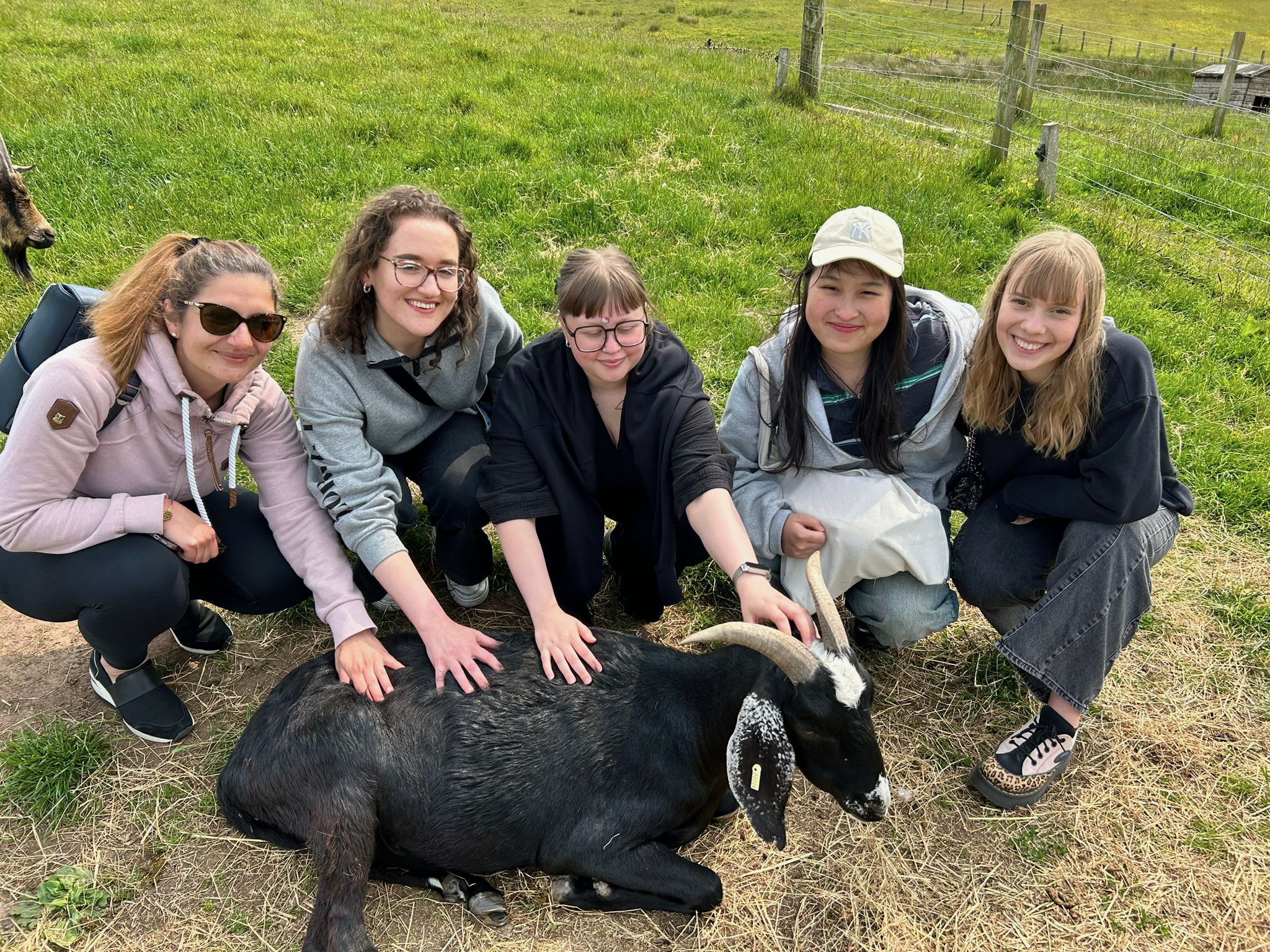
  <img src="/assets/images/posts/2025-06-08-spring-summer/oreo_team.jpeg" alt="The Team with our goat mascot Oreo!" />
  <figcaption>Thursday 31 October — Halloween and PIP Extravaganza, i.e. we are on our way to a joint lab meeting with David Bryant's group at CRUK Scotland in Glasgow</figcaption>
</figure>]]></content><author><name>Ralitsa Madsen</name></author><category term="lab-news" /><summary type="html"><![CDATA[Over the past two months, we've welcomed new members (both human and goat), said goodbye to a longstanding colleague, and connected with the wider PI3K research community.]]></summary></entry><entry><title type="html">Giving It Back</title><link href="https://rmlab2023.github.io/news/2025/05/06/giving-it-back/" rel="alternate" type="text/html" title="Giving It Back" /><published>2025-05-06T00:00:00+00:00</published><updated>2025-05-06T00:00:00+00:00</updated><id>https://rmlab2023.github.io/news/2025/05/06/giving-it-back</id><content type="html" xml:base="https://rmlab2023.github.io/news/2025/05/06/giving-it-back/"><![CDATA[<h1 id="giving-it-back">Giving it back</h1>

<p>It is hard to believe, but it is now almost a year since I got the fantastic news that my <strong>Future Leaders Fellowship application (Round 8)</strong> had been successful. I had promised myself that I would share some of my learnings with future applicants — whether or not I got the Fellowship. So here I am, writing up what I should have put together already a year ago. Apologies for the delay, but time and energy turned out to be limiting resources after a whirlwind of a year.</p>

<h2 id="why-a-recipe">Why a recipe?</h2>

<p>I have decided to structure this guiding post as a <strong>cooking recipe</strong>. Now, remember that you are free to ignore all of it — there are many paths to success. This is just my personal experience, and some context is probably key to share upfront.</p>

<p>I am a <strong>biomedical scientist</strong>, with a strong passion for advancing a quantitative approach to understanding and treating diseases of aberrant cell communication.</p>

<p>As I was applying for the FLF, I still had 1.5 years left of my <strong>Sir Henry Wellcome Postdoctoral Fellowship</strong>. I had started this fellowship at <strong>UCL</strong>; however, halfway through, I got an opportunity to start my independent lab at the <strong>MRC PPU in Dundee</strong>, so I moved.</p>

<p>This meant that, by the time I was given the opportunity to apply for the FLF, there was <strong>only one month to go</strong> to submission — a place had just been freed up as another candidate was successful with a separate fellowship application.</p>

<p>In other words, because I had not yet arrived at the University of Dundee when the internal FLF candidate selection took place, my actual application journey was <strong>very unusual</strong> and perhaps <strong>excessively stressful</strong> for the same reason. But hey, I got it — so here is the wisdom I can share!</p>

<p>My success was really all down to ensuring that all the below <strong>ingredients</strong> were in place when I got the opportunity. You will hopefully get the opportunity with <strong>plenty of time</strong> to secure all ingredients if you do not have them already.</p>

<h2 id="my-flf-ingredients-list">My FLF ingredients list</h2>

<h3 id="1-a-strong-vision">1. A strong vision</h3>

<ul>
  <li>This is <strong>key</strong>. Practise articulating your vision out loud and imagine being an external listener. Ask yourself:</li>
  <li><em>“So what? Why fund this? Who cares?”</em></li>
  <li>If you can give a convincing and pithy answer, you’ve nailed it.</li>
  <li>Think beyond your own research agenda:</li>
  <li>Is it clear that your vision has the potential to be transformative in terms of understanding and/or application?</li>
  <li>Is it clear how the delivery of your programme will add value to UK R&amp;D?</li>
  <li><em>Hint: check key strategy documents from UKRI and the UK Government to understand what their priority areas are and how you may contribute — be specific.</em></li>
  <li>Be prepared to articulate the kind of (big) change — in research and in your career — an FLF will enable <strong>4, 7, 10+ years from now</strong>.</li>
  <li>Final tip: think of ways in which your interdisciplinary research vision naturally ties in with aspects of <strong>research culture</strong> that UKRI care about (e.g. highly interdisciplinary project, team science, recognition of diverse skillsets, and career development for trainees).</li>
</ul>

<h3 id="2-prior-impact-in-research-and-beyond">2. Prior impact in research and beyond</h3>

<ul>
  <li>What have you done so far to evidence your <strong>future leader potential</strong>?</li>
  <li>This is tough — but you need to demonstrate credentials in research and beyond:</li>
  <li>Demonstrable <strong>research impact</strong></li>
  <li>Engagement with <strong>research culture</strong>, <strong>open science</strong>, and related efforts — not as box-ticking, but because you care about doing better research</li>
  <li>Strong examples of how you support team development, inspire leadership, and ensure a <strong>welcoming and open environment</strong></li>
  <li>Familiarise yourself with the <strong>FLF Development Network</strong> and the ways you’ll benefit from it — be genuine and specific.</li>
</ul>

<h3 id="3-a-realistic-plan">3. A realistic plan</h3>

<p>You’ve got your vision — now, how are you going to deliver it?</p>

<ul>
  <li>The plan must be <strong>realistic</strong> and convey long-term potential.</li>
  <li>Consider:</li>
  <li>Key experiments/models and who/what is needed</li>
  <li>Short-, mid-, and long-term deliverables</li>
  <li>Clear work packages/aims — are they <strong>independent enough</strong> to allow progress if one fails?</li>
  <li>Success measures</li>
  <li>Risk management strategies</li>
  <li>Above all, show how your plan can <strong>only be delivered through the FLF mechanism</strong>:</li>
  <li>The long-term support, skill-building, and integration you propose wouldn’t be possible via multiple, smaller grants.</li>
</ul>

<h3 id="4-big-picture-overview">4. Big picture overview</h3>

<ul>
  <li>Know your field inside-out.</li>
  <li>Why is your research competitive?</li>
  <li>What makes your programme <strong>unique</strong>?</li>
  <li>Are you sure you’ve considered all alternative methods/approaches?</li>
  <li>Acknowledge strengths and limitations — it builds trust.</li>
</ul>

<h3 id="5-the-right-host-institution">5. The right host institution</h3>

<ul>
  <li>The ideal host should offer:</li>
  <li>The right <strong>research culture</strong></li>
  <li>Tangible support for <strong>you and your team</strong></li>
  <li>A lab and office are fine — but the <strong>bare minimum</strong>.</li>
  <li>The stronger their support, the more they demonstrate belief in <strong>you as an investment</strong>.</li>
  <li>Show why this institution is the one to help you <strong>deliver your vision</strong>.</li>
</ul>

<h3 id="6-strong-collaborators">6. Strong collaborators</h3>

<ul>
  <li>Similar to the host institution, your collaborators must:</li>
  <li>Provide support in areas where <strong>you’re less experienced</strong></li>
  <li>Offer tangible, ideally <strong>in-kind</strong> support</li>
  <li>Their letters should be <strong>genuine and personal</strong> — showing real belief in you.</li>
  <li>Don’t name-drop — symbolic collaborations will hurt your application.</li>
  <li>Articulate how you’ll <strong>manage the collaboration</strong>:</li>
  <li>Site visits?</li>
  <li>Virtual meetings?</li>
  <li>Exchange arrangements?</li>
  <li>Fit this into your <strong>justification for resources</strong>, too.</li>
</ul>

<h3 id="7-good-mentors">7. Good mentor(s)</h3>

<ul>
  <li>You’ll need mentors for both your career and your FLF journey.</li>
  <li>Think about the <strong>type of mentorship</strong> you need:</li>
  <li>Expertise? Support navigating identity and career? Strategic advice?</li>
  <li>For example, I chose a <strong>female mentor</strong> who shared my cultural background. Her experience and understanding were key.</li>
</ul>

<h3 id="8-supportive-colleagues">8. Supportive colleagues</h3>

<ul>
  <li>You’ll need them — inside and outside your institution.</li>
  <li>Get feedback from:</li>
  <li><strong>Colleagues outside your field</strong> — your panel may be generalist</li>
  <li><strong>Experienced reviewers</strong> — ideally with UKRI panel experience</li>
  <li>Ask colleagues to read your application with a <strong>devil’s advocate</strong> lens.</li>
  <li>Share your rebuttal letter. Do <strong>mock interviews</strong> — many, not just one or two.</li>
  <li>Accept feedback, even when it stings. <strong>You need this</strong> to improve.</li>
  <li>One of the biggest mistakes? Not being open to feedback, or leaving it too late.</li>
</ul>

<h3 id="9-a-robust-budget">9. A robust budget</h3>

<ul>
  <li>Get your costings right — <strong>early</strong>.</li>
  <li>Work closely with your <strong>research finance team</strong>.</li>
  <li>Justify everything clearly.</li>
  <li>Be aware of <strong>conditions on large requests</strong>, e.g. capital equipment may require a business case (I had to write one!).</li>
</ul>

<h3 id="10-successful-prior-application-examples">10. Successful prior application examples</h3>

<ul>
  <li>Learn from others — especially recent ones.</li>
  <li>What patterns do you notice in strong applications?</li>
  <li>Vision</li>
  <li>Impact</li>
  <li>Clarity</li>
  <li>Don’t copy, but do take inspiration.</li>
</ul>

<h2 id="assembling-the-proposal">Assembling the proposal</h2>

<p>Once you have your ingredients, you’ll need to <strong>mix them just right</strong>.</p>

<ul>
  <li>Write with <strong>clarity of thought</strong> — not easy!</li>
  <li>Be prepared to go through <strong>10+ versions</strong> before submission.</li>
  <li>You won’t be able to cover everything — there’s an art to <strong>selecting what matters most</strong>.</li>
  <li>Every paragraph should support one or more <strong>FLF assessment criteria</strong> — memorise them and <strong>cut anything that doesn’t help</strong>.</li>
  <li>Reviewers understand the space limitations — so think creatively:</li>
  <li>Use visuals</li>
  <li>Be concise</li>
  <li>Get others to help prune unnecessary details</li>
</ul>

<h2 id="the-interview">The interview</h2>

<p>If you get this far — <strong>congratulations!</strong> You’ve already done brilliantly.</p>

<p>Use the month before your interview <strong>strategically</strong>.</p>

<ul>
  <li>Don’t stop at two mocks — do several.</li>
  <li>Assign different focus areas to each practice session.</li>
  <li>Your slides must be <strong>crystal clear</strong> — ideally, your vision is self-explanatory.</li>
  <li>I reworked mine completely after the first mock!</li>
  <li>Practise your <strong>5-minute pitch</strong> relentlessly — but don’t sound like a robot.</li>
  <li>My non-English-speaking mother was visiting the week before my interview. I dragged her on long walks along the Tay river and delivered my pitch on repeat.</li>
  <li>Be authentic, passionate — and prepared.</li>
  <li>Study UKRI’s <strong>interview guidance</strong> and <strong>example questions</strong>. They may not ask them word-for-word, but the themes will appear. <strong>Prepare answers in advance</strong>.</li>
</ul>

<h2 id="final-thoughts">Final thoughts</h2>

<p>I wish you all the best of luck — you’ve got this!</p>]]></content><author><name>Ralitsa Madsen</name></author><category term="fellowship" /><category term="reflections" /><summary type="html"><![CDATA[Reflections on the responsibility that comes with public funding and the importance of giving back to the scientific community and beyond.]]></summary></entry><entry><title type="html">An Autumnal Update — 10.11.2024</title><link href="https://rmlab2023.github.io/news/2024/11/10/autumnal-update/" rel="alternate" type="text/html" title="An Autumnal Update — 10.11.2024" /><published>2024-11-10T00:00:00+00:00</published><updated>2024-11-10T00:00:00+00:00</updated><id>https://rmlab2023.github.io/news/2024/11/10/autumnal-update</id><content type="html" xml:base="https://rmlab2023.github.io/news/2024/11/10/autumnal-update/"><![CDATA[<p>It has been quite a busy time in the Madsen Lab, or Madness (!) as we also like to call ourselves. The team is growing, new projects have started, and deadlines are always looming in the background. A few musings inspired by events in the past months. Some good, some bad, and some simply okay!</p>

<p>Fingers crossed that we are close to the finish line with the formal publication of our key <strong>paper</strong> on how information transfer is corrupted in cells with an activating PIK3CA mutation. This also includes our new framework for measuring single-cell PI3K signalling with high quantitative precision. What a labour of love and quite the journey when it comes to publishing! We have not had to do a single new experiment, and yet it is now nearly a year since first submission. The key reasons for this protracted process are delays at the initial journal that handled our paper, some unfortunate misunderstandings and poor behaviour from one editor and, ultimately, a decision by us to take the paper somewhere else where we would be treated with respect. There will be more on this experience in future, as there are important lessons that I would like to share with the wider community. For now, just a reminder to colleagues and friends that we all do our best and deserve to be treated with care and respect, not only by reviewers but also by editors. This is so important if we want to break away from the old and rather brutal system of “publish or perish” which pushes so many of our best trainees out of academia. On a brighter note, we are really excited about the publication venue that is now handling our paper and, for a variety of reasons, this is a much more suitable home for our work. More on this once the paper is out!</p>

<p>In September 2024, the lab had only two members: myself and my student Oliwia Mruk, now starting her PhD. Soon after, we were joined by Sabrina Low (previously a summer student, now an honours student) and Alex Musk (a Wellcome Trust PhD student on a rotation project). Just last week, Saira Ashraf joined us as a senior research technician. From 2 to 5 in less than two months! There is nothing more satisfying for a PI than to build and nurture a team of kind and hard-working individuals, who care not only about the work that they do but also about the environment within which they work. At the beginning, everyone needs to be given the time to learn and develop key skills, which requires tolerance to inevitable mistakes and understanding that, actually, mistakes are the best teachers for everybody. We learn from them and we try to avoid them in future. I am grateful that my team is conscientious and diligent, with a shared understanding of how important research integrity is to all that we do. That said, I am under no illusion that I have the main responsibility for ensuring that they are empowered to think creatively and to achieve what they have set out to do. This is no easy task for a young PI, and so I was really happy to have the opportunity to attend EMBO’s Lab Leadership Course for three full days earlier this week. I learnt a lot, and a lot will need continued revision and consolidation, but I am excited to apply the new tools and methods in my efforts to ensure a healthy and productive research culture within the lab. I hope that my team will also understand that this is a learning experience for me, and so I will not always get it right, but I promise to try my best!</p>

<p>I cannot remember where I read it, but I did come across a statement that we spend more time with the people in our labs than with our families! To me, this really illustrates the importance of ensuring that the lab is a welcoming place for everybody and that we remember to have fun amidst all the hard work. And so, as I end this blogpost, I hope the smiles of the team in the below photos will also bring a smile to your face wherever and whoever you are! (P.S. Check out our <strong><a href="/pages/people/">Want to join us</a></strong> page if you think you are missing from the photos below, and get in touch with Ralitsa!)</p>

<figure>
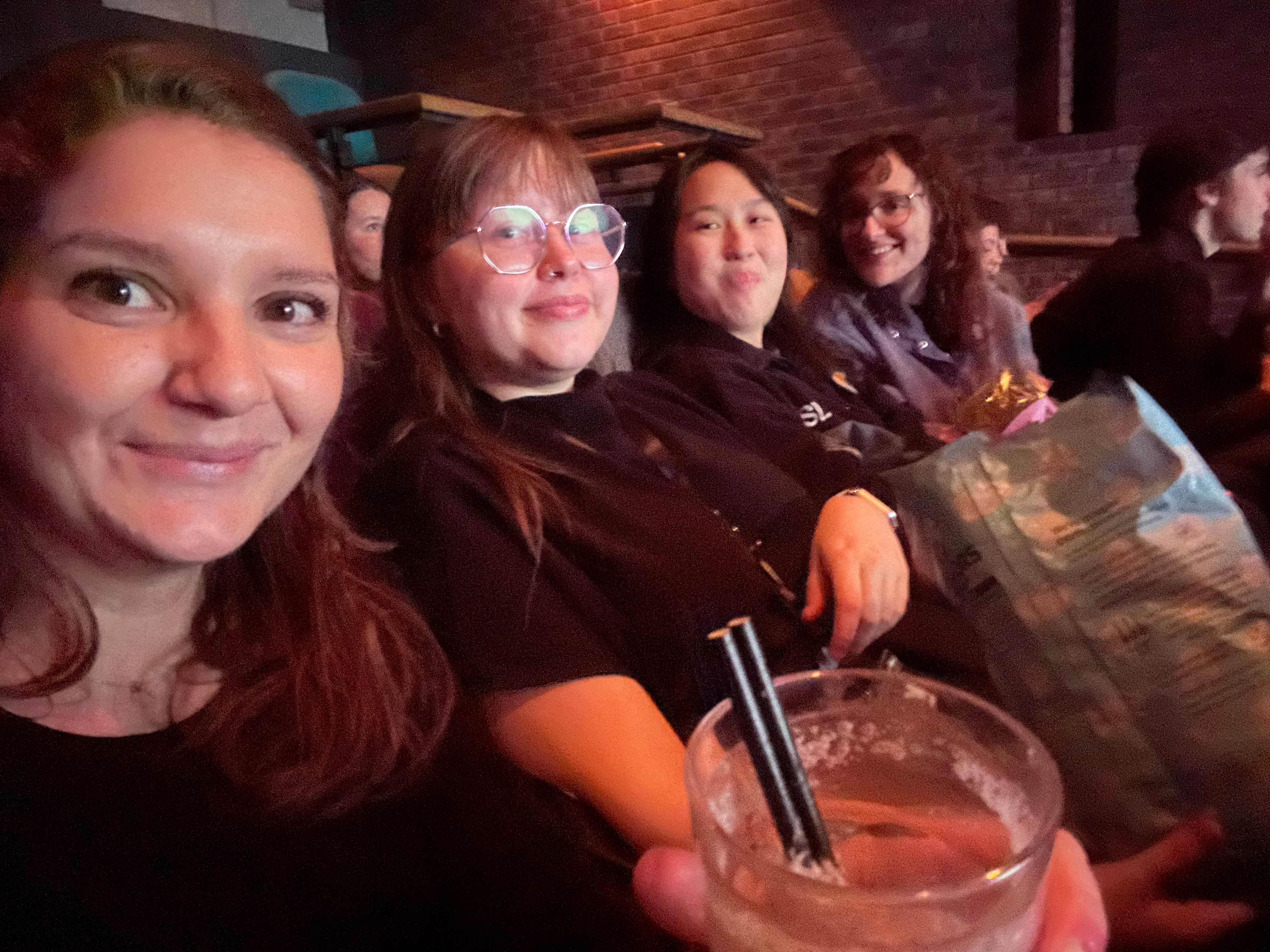
  <img src="/assets/images/posts/2024-11-10-autumnal/cinema.jpeg" alt="In the cinema about to watch Paddington in Peru" />
  <figcaption>Friday 8 November — we are in the cinema about to watch Paddington in Peru</figcaption>
</figure>

<figure>
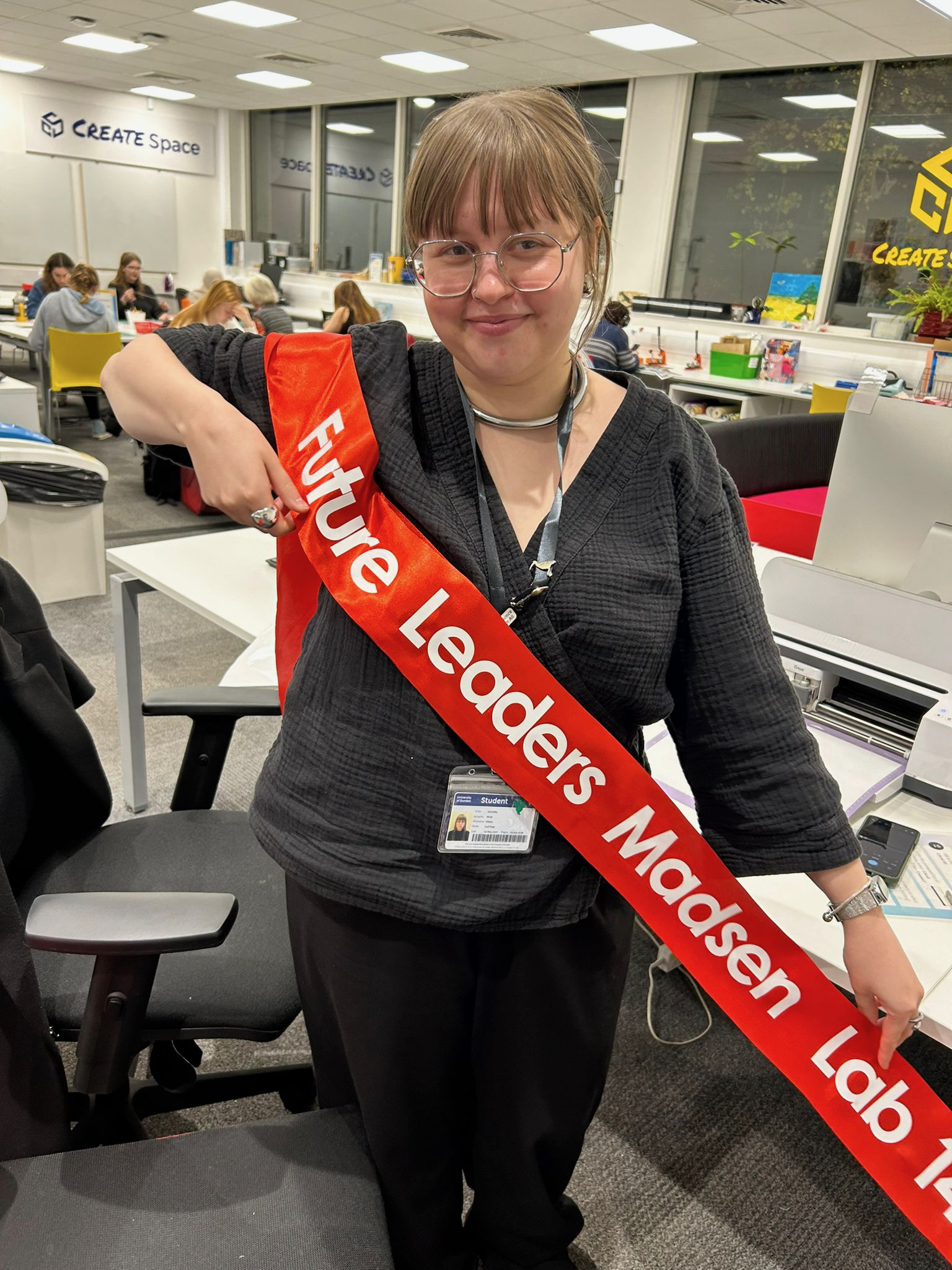
  <img src="/assets/images/posts/2024-11-10-autumnal/oliwia_FLF.jpeg" alt="Oliwia and Sabrina being creative in Create Space" />
  <figcaption>Thursday 7 November — Oliwia and Sabrina are being creative in Create Space, in preparation for the start of the Madsen Lab Future Leaders Fellowship</figcaption>
</figure>

<figure>
  <img src="/assets/images/posts/2024-11-10-autumnal/glasgow_trip.jpeg" alt="On the way to a joint lab meeting in Glasgow" />
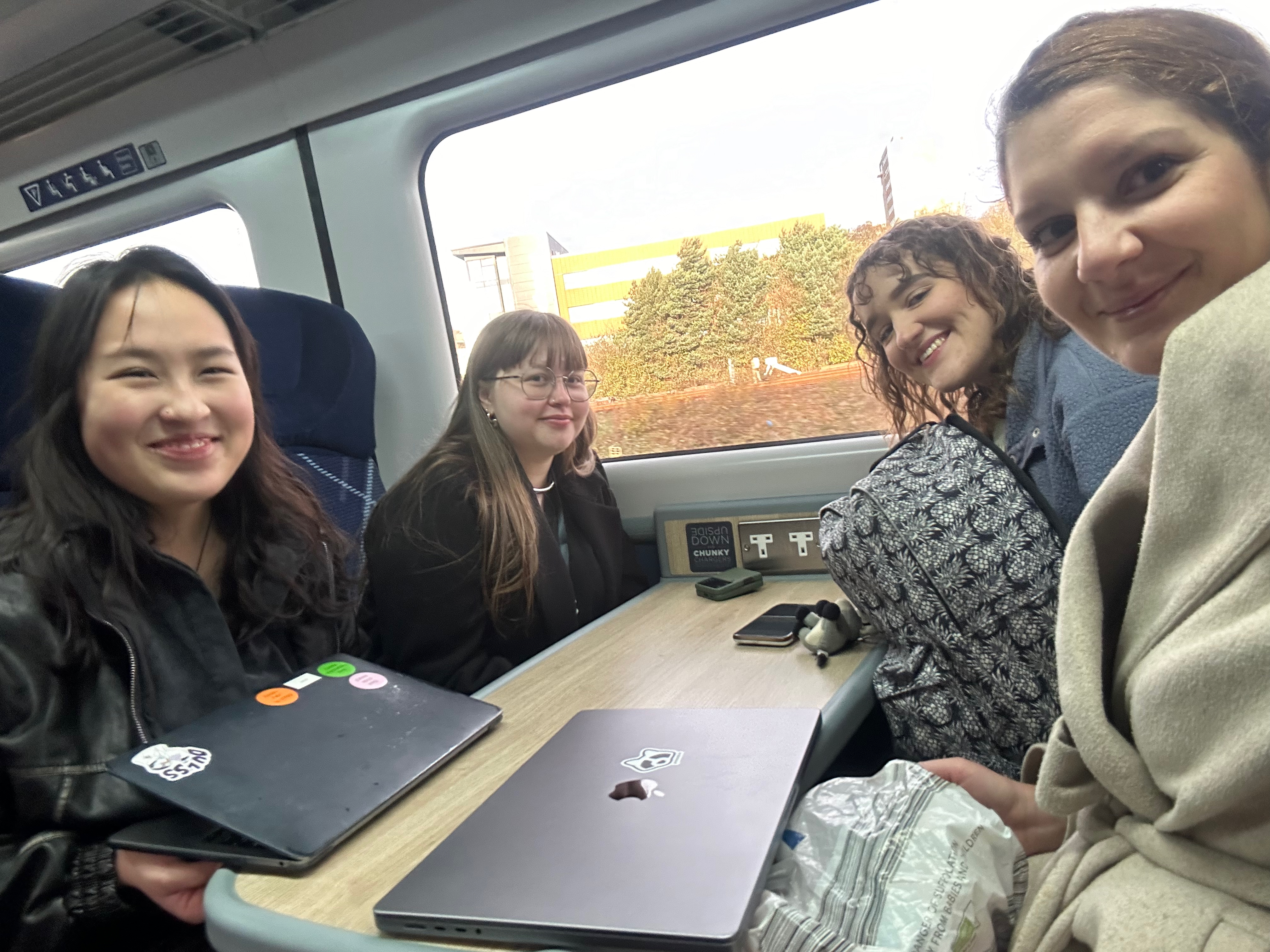
  <figcaption>Thursday 31 October — Halloween and PIP Extravaganza, i.e. we are on our way to a joint lab meeting with David Bryant's group at CRUK Scotland in Glasgow</figcaption>
</figure>]]></content><author><name>Ralitsa Madsen</name></author><category term="lab-news" /><summary type="html"><![CDATA[The team is growing, new projects have started, and deadlines are always looming in the background. A few musings inspired by events in the past months. Some good, some bad, and some simply okay!]]></summary></entry></feed>